



Introduction
Making the perfect decision when starting an investment or opening a trade is one of the biggest psychological challenges for both beginners and experienced traders. The fear of losing money, the pressure of timing the market, and the noise of contradictory information can paralyze even the most disciplined investors.
In this guide, you’ll learn a step-by-step, psychology-driven framework to evaluate opportunities with clarity, confidence, and precision. We’ll explore how emotions shape your decision-making, how to build a repeatable process, and how to reduce hesitation — so every trade or investment becomes intentional rather than impulsive.
Why Most Investors Struggle to Make Good Decisions
1. Emotional Biases That Distort Investment Choices


Even skilled traders fall into emotional traps. Some of the most common include:
- Fear of Missing Out (FOMO) leads to rushed entries.
- Loss aversion makes you avoid great opportunities because of past losses.
- Overconfidence pushes you into oversized positions.
- Confirmation bias makes you seek information that supports your preferred direction.
These biases don’t mean you’re inexperienced — they mean you’re human. The goal isn’t to eliminate emotions, but to design a system strong enough to protect you from impulsive behavior.
The Psychology-First Framework for Making the “Perfect” Investment Decision
2. Define Your Decision Environment Before You Decide
Before looking at any price chart or asset:
Ask yourself three foundational questions (H3):
- What is my objective? (Growth, income, speculation, hedge?)
- What is my acceptable risk?
- What is my time horizon?
This clarity alone eliminates 70% of bad trades, because mistakes usually come from decisions made without a predefined context.
3. Build a Simple, Repeatable Checklist
A consistent checklist reduces emotional interference and improves accuracy.
Here’s a proven example:
Trading/Investment Decision Checklist (H3)
- Do I fully understand the asset or market?
- Is my entry based on analysis, not emotion?
- Where is my invalidation point (stop-loss or thesis-breaker)?
- Does the position size align with my risk tolerance?
- Is the timing appropriate, or am I reacting to noise?
The key is consistency — the perfect decision is rarely the one that feels exciting, but the one that follows your system.
4. Use the 3A Method: Analyse, Anticipate, Act


Analyse
Examine fundamentals, technicals, sentiment, and macro context. Look for confluence, not perfection.
Anticipate
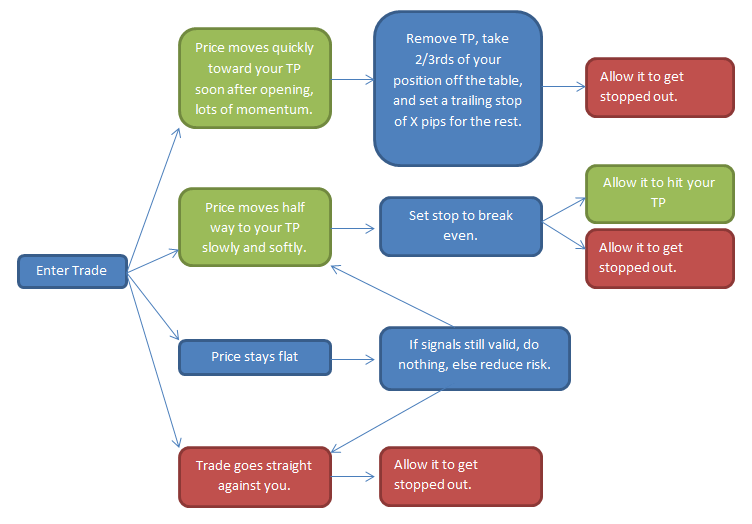
Define scenarios:
- What if price goes in my favor?
- What if it goes against me?
- What would a neutral or sideways environment look like?
This reduces panic during volatility because you’ve mentally pre-lived the possibilities.
Act
Execute with discipline. A good decision executed late becomes a bad one.
Use automation when possible: alerts, stop-loss, limit orders.
Read also: How Mindfulness Improves Your Investing Performance
5. Build Your Confidence Through Pre-Commitment
Investors who decide “in the moment” rely on emotion.
Investors who decide before the moment rely on strategy.
Use pre-commitment tools such as:
- Written trade plans
- Pre-market preparation
- Journaling entries and exits
- Defining the reason why this trade matters to you
Pre-commitment removes the ambiguity that typically causes hesitation.
6. The Perfect Decision Is Not the One That Wins — It’s the One That Follows Your Strategy
One of the biggest psychological errors is judging decisions only by outcomes.
A trade can be good and still lose money if conditions shift.
A trade can be bad and still win if luck intervenes.
Professional investors judge decisions based on process quality, because process is repeatable — luck is not.
Conclusion
Making the perfect investment or trade decision isn’t about predicting the market flawlessly. It’s about designing a rational, repeatable, and emotionally resilient process that protects you from impulsive choices and increases your consistency over time.
By understanding your emotional biases, clarifying your objectives, using a structured checklist, and applying the 3A Method, you transform uncertainty into confidence.
If you want to elevate your decision-making even further, start applying these steps to your next trade — and watch how your clarity improves.
3 thoughts on “Mastering Investment Decisions: A Psychological Approach”