


Introduction
In a world overloaded with noise, opinions, and distorted information, clear thinking has become one of the rarest competitive advantages. Markets reward those who can see reality as it is — not as others wish it to be. Few investors in history embodied this discipline more deeply than Charlie Munger. His influence shaped not only one of the most successful investment partnerships of all time, but an entire philosophy of rational decision-making.
In this article, you’ll discover how Charlie Munger trained his mind for extreme clarity, why he believed most people fail not because they lack intelligence but because they think incorrectly, and how his system of mental discipline helps neutralize bias, emotional error, and distorted perception. These principles apply not only to investing — but to every serious decision in life.
1. Why Clear Thinking Is Rarer Than Intelligence
Munger believed that:
“The problem isn’t IQ. It’s psychological misjudgment.”
Many people are intelligent.
Few people think clearly under pressure.
1.1 Intelligence Without Discipline Creates Illusion
Without discipline, intelligence becomes a tool for:
- rationalizing bad decisions
- defending ego
- justifying emotional bias
- building elegant excuses
Brilliant minds can fail catastrophically without mental hygiene.
1.2 Why the World Constantly Distorts Your Thinking
Your perception is attacked by:
- media sensationalism
- social pressure
- financial incentives
- emotional contagion
- confirmation bias
- herd mentality
Clear thinking requires active resistance, not passive consumption.
2. Munger’s Core Belief: Avoiding Stupidity Beats Seeking Brilliance


While most people chase brilliance, Munger focused on avoiding obvious stupidity.
2.1 The Power of Inversion
Instead of asking:
- “How can I succeed?”
He asked:
- “How could I fail spectacularly?”
Then he avoided those conditions obsessively.
2.2 Why Not Losing Beats Trying to Win
You don’t need genius-level success rates.
You need:
- to avoid ruin
- to avoid leverage traps
- to avoid emotional decisions
- to avoid blind optimism
Survivability compounds.
Brilliance without survival does not.
3. The Mental Models Framework: Thinking in Systems


Munger believed that most people think with single-layer logic.
He trained himself to think with multiple interacting models.
3.1 What Mental Models Really Are
Mental models are:
- simplified representations of how reality works
- frameworks that explain cause and effect
- tools to predict second-order consequences
Examples:
- incentives
- compounding
- opportunity cost
- regression to the mean
- feedback loops
- critical mass
3.2 Why Single-Model Thinking Is Dangerous
When you use only one model:
- you oversimplify reality
- you miss interacting forces
- you misread risk
- you misjudge timing
Reality is multi-causal.
Your thinking must be too.
4. Incentives: The Most Powerful Psychological Force
Munger famously said:
“Show me the incentive, and I’ll show you the outcome.”
4.1 Why Incentives Override Ethics, Logic, and Intelligence
People respond to:
- money
- career survival
- reputation
- status
- bonuses
- fear of punishment
Even very smart people behave irrationally under distorted incentives.
4.2 How This Destroys Investors
Misaligned incentives appear in:
- analysts
- fund managers
- financial media
- social media influencers
- even corporate executives
Clear thinkers analyze who benefits, not just what is said.
5. Psychological Misjudgment: The Real Enemy of Return
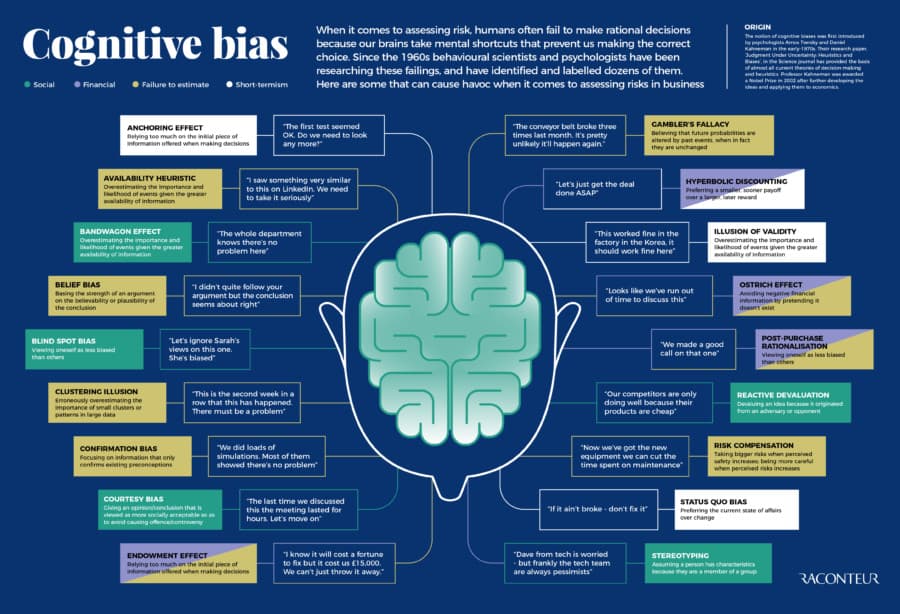

Munger identified dozens of recurring psychological errors, including:
- social proof
- authority bias
- reciprocity
- consistency bias
- loss aversion
- commitment bias
- overconfidence
- envy and jealousy
5.1 Why Biases Rarely Act Alone
Biases don’t appear in isolation.
They stack, amplify, and reinforce each other.
For example:
- loss aversion + social proof = panic selling
- overconfidence + incentives = excessive leverage
- commitment bias + ego = refusal to exit
This is how intelligent people make catastrophic decisions.
6. Munger’s Relationship With Uncertainty
Unlike most investors, Munger was not disturbed by uncertainty.
He was disturbed by false certainty.
6.1 Why Needing Certainty Is a Psychological Weakness
The desire for certainty leads to:
- narrative addiction
- overtrading
- premature conclusions
- illusion of control
Reality is probabilistic.
But most minds crave absolutes.
6.2 Thinking in Probabilities, Not Predictions
Munger thought in:
- odds
- ranges
- scenarios
- base rates
- downside exposure
This removes emotional rigidity from decision-making.
7. How Munger Partnered With Buffett Without Ego


The partnership between Munger and Warren Buffett worked not because of agreement — but because of intellectual honesty.
7.1 Disagreement as a Feature, Not a Threat
They challenged each other relentlessly.
No emotional protection.
No status games.
No intellectual ego.
Truth always outranked comfort.
7.2 Why Most Teams Fail Psychologically
Most teams suffer from:
- hierarchy bias
- fear of conflict
- desire for harmony
- authority pressure
This kills objective thinking.
Munger believed:
“You don’t need agreement. You need correctness.”
8. Why Munger Rejected Complexity and Fashion
Munger distrusted:
- fashionable ideas
- financial engineering
- overly complex models
- impressive-sounding jargon
8.1 Why Complexity Is a Psychological Trap
Complexity:
- hides risk
- creates false authority
- reduces transparency
- makes blame diffuse
Simple systems fail visibly.
Complex systems fail invisibly.
9. Practical Mental Discipline You Can Apply Immediately


Here is a Munger-style mental discipline framework you can use now:
9.1 Always Run an Inversion Check
Ask:
- “How could this go terribly wrong?”
9.2 Identify Incentives Before Trusting Information
Ask:
- “Who benefits if I believe this?”
9.3 Reduce The Number of Decisions You Make
Fewer decisions → fewer emotional errors.
9.4 Build a Personal Lattice of Models
Study:
- psychology
- economics
- statistics
- business
- history
Cross-pollination builds clarity.
9.5 Eliminate What Is Obviously Stupid
You don’t need to be brilliant.
You must avoid:
- leverage you don’t understand
- businesses you can’t explain
- environments that trigger emotion
- strategies you copy without logic
10. The Psychological Legacy of Charlie Munger
Munger’s greatest gift was not stock picking.
It was the demonstration that:
- rationality is trainable
- bias is predictable
- discipline beats brilliance
- avoiding stupidity compounds faster than chasing genius
He proved that clear thinking is the ultimate superpower in distorted environments.
Conclusion: Clear Thinking Is a Competitive Advantage
Most people try to think faster.
Munger taught us to think cleaner.
He didn’t fight markets with prediction.
He fought them with:
- inversion
- discipline
- incentives
- humility
- probabilistic thinking
If you train your mind to:
- see incentives clearly
- detect bias early
- avoid emotional traps
- think in systems
- and accept uncertainty
You won’t just become a better investor.
You’ll become a harder mind to deceive — including by yourself.
Frequently Asked Questions
What is the bandwagon effect in investing?
The bandwagon effect in investing is the tendency to buy assets simply because many others are buying them — using popularity as a proxy for quality. It is distinct from rational herding and reflects the human instinct to assume that crowd consensus reflects superior information.
How does the bandwagon effect create bubbles?
As more investors buy an asset, rising prices create social proof that attracts more buyers, which drives prices further, attracting even more buyers. This self-reinforcing cycle detaches price from fundamental value until the gap becomes unsustainable and reversal is violent.
How is the bandwagon effect different from momentum investing?
Momentum investing uses documented statistical patterns in price trends. The bandwagon effect is a psychological bias — investing based on social popularity without regard to price, value, or statistical edge. Both involve buying rising assets, but for very different reasons with very different outcomes.
How can I avoid the bandwagon effect in my investment process?
Before investing in any popular asset, independently evaluate it against fundamental criteria. Ask: “Would I invest in this if nobody else was?” If the answer is no, popularity is the driver, not analysis. The time an asset is most widely discussed is often the worst time to buy it.
Further Reading
- What Buffett, Munger, and Marks All Agree On About Human Behavior
- A Buffett-Style Behavioral Portfolio Framework (Step-by-Step)
- Financial Psychology: How Emotions and Cognitive Biases Shape Every Investment Decision

Written by
Monteiro
Investor · Behavioral Finance Writer · 20+ Years of Market Experience
life enthusiast, self-proclaimed scientist, philosopher, ...
📬 Enjoyed this article?
Follow along for new insights on behavioral finance, investor psychology, and long-term thinking.
2 thoughts on “Charlie Munger’s Mental Discipline: How to Think Clearly in a Distorted World”