


Introduction
Few things are more dangerous in investing than success.
After a series of winning trades or a strong market run, investors often feel smarter, more skilled, and more in control than before. Confidence grows, caution fades, and risk suddenly feels manageable—unnecessary. This is not coincidence. It’s Overconfidence Bias at work.
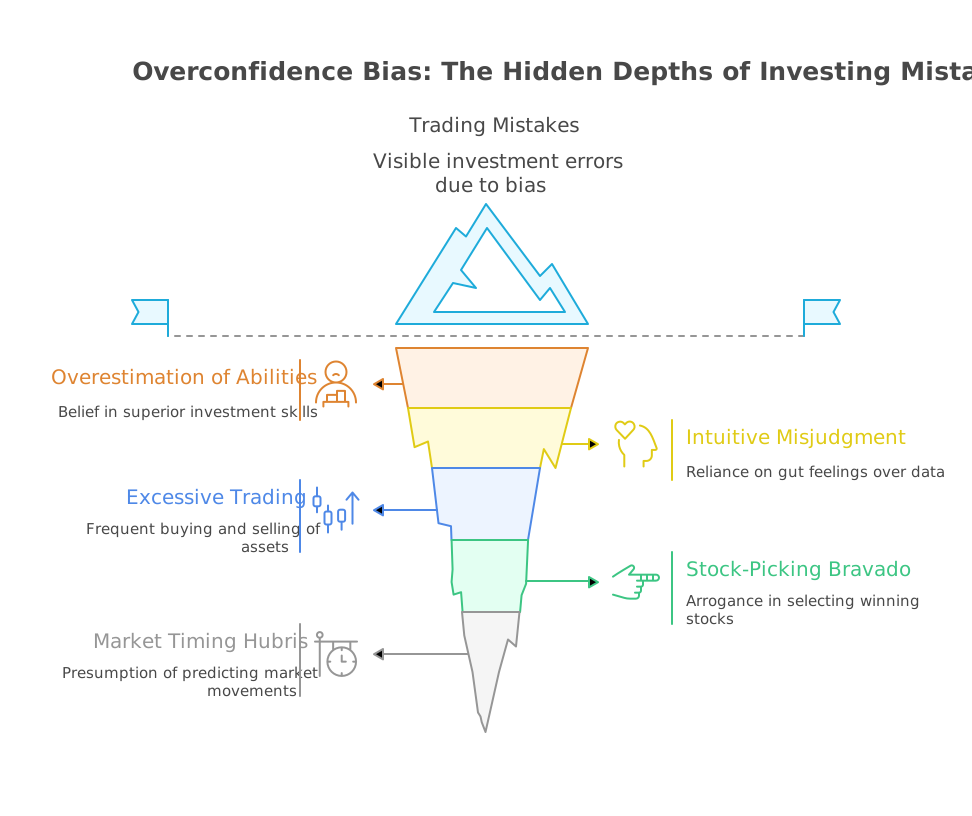
Overconfidence bias is one of the most destructive psychological traps in financial markets. It convinces investors that their recent success came from skill rather than luck, that they understand risk better than others, and that past rules no longer apply. Many major losses don’t happen after mistakes—but after winning streaks.
In this article, you’ll learn why overconfidence emerges after success, how it quietly increases risk, and how to prevent confidence from turning into complacency.
What Is Overconfidence Bias?
Overconfidence bias is the tendency to overestimate:
- One’s knowledge
- One’s predictive ability
- One’s control over outcomes
In investing, it shows up when people believe:
- “I understand this market better than most”
- “My results prove my skill”
- “I can manage risk when things turn”
The problem isn’t confidence itself.
The problem is confidence detached from reality.
Why Success Triggers Overconfidence
Success feels like proof.
But markets are noisy environments where luck and timing play a major role.
The Brain’s Misinterpretation of Results
After success, the brain:
- Attributes wins to skill
- Downplays randomness
- Builds a narrative of competence
This happens automatically—and subconsciously.
Behavioral research, popularized by Daniel Kahneman, shows that humans consistently confuse outcomes with ability, especially in uncertain environments like markets.
Skill vs Luck: The Most Dangerous Confusion in Investing
In the short term:
- Luck dominates outcomes
- Randomness looks like pattern
In the long term:
- Skill reveals itself
- Discipline matters
Overconfidence bias thrives when investors mistake short-term success for long-term ability.
This is why:
- Bull markets create “experts”
- Everyone looks smart near market tops
- Risk-taking peaks before losses appear
How Overconfidence Bias Shows Up in Real Decisions
1. Increasing Position Size After Wins
After success, investors often think:
“I’ve earned the right to take more risk.”
Result:
- Larger positions
- Higher leverage
- Bigger drawdowns when things go wrong
Risk expands faster than skill.
2. Ignoring Risk Management Rules
Rules feel restrictive when confidence is high.
Common behaviors:
- Skipping stop-losses
- Abandoning diversification
- “Just this once” exceptions
Overconfidence turns safeguards into inconveniences.
3. Overtrading
Confident investors trade more:
- More signals
- More activity
- More commissions and mistakes
Studies consistently show that higher trading frequency leads to lower net returns, largely due to overconfidence.
4. Believing You Can “Handle It” If Things Go Wrong
Overconfidence bias convinces investors they will:
- React calmly under stress
- Exit at the right time
- Control emotions later
In reality, emotions are strongest precisely when confidence collapses.
The Illusion of Control
Overconfidence feeds the illusion that:
- Markets are predictable
- Skill dominates randomness
- Outcomes can be managed in real time
But markets are complex systems with:
- Feedback loops
- Uncertainty
- Uncontrollable variables
Feeling in control does not mean being in control.
Why Overconfidence Is Stronger After Success Than Failure
Failure hurts—but it also teaches.
Success:
- Reinforces behavior
- Reduces self-doubt
- Discourages reflection
Losses force humility.
Wins inflate ego.
This asymmetry explains why many investors experience their largest losses after their best periods.
Overconfidence Across Investor Levels
Beginners
- Early wins create false confidence
- Risk is underestimated
Intermediate Investors
- Complexity increases
- Skill is overestimated
Advanced Investors
- Ego becomes the risk
- Narratives replace rules
Experience changes the form of overconfidence—but rarely eliminates it.
Why Intelligence Makes Overconfidence Worse
Smart investors are often:
- Better at storytelling
- Better at rationalization
- Better at defending poor decisions
High IQ increases confidence—but not necessarily accuracy.
The ability to explain a decision does not make it correct.
Market Conditions That Amplify Overconfidence
Overconfidence bias thrives during:
- Bull markets
- Low volatility periods
- Long winning streaks
When markets are calm:
- Risk feels low
- Feedback is positive
- Caution feels unnecessary
Ironically, this is when risk is often highest.
The Real Cost of Overconfidence Bias
Overconfidence doesn’t just reduce returns. It causes:
- Excessive drawdowns
- Emotional shock when losses arrive
- Loss of discipline
- Strategy abandonment
Many investors don’t fail slowly—they fail suddenly, after confidence peaks.
How to Protect Yourself From Overconfidence Bias
You can’t eliminate confidence.
But you can anchor it to reality.
1. Judge Decisions, Not Outcomes
A good process can lose.
A bad process can win.
Evaluate yourself by:
- Rule adherence
- Risk discipline
- Consistency
Not by short-term profits.
2. Cap Risk After Wins (Not Just After Losses)
Most investors reduce risk after losses.
Few reduce risk after gains.
Set rules such as:
- Maximum position size regardless of confidence
- Cooling-off periods after winning streaks
Confidence should trigger caution—not expansion.
3. Keep Written Rules—and Follow Them
Written rules expose overconfidence.
If you break rules during winning periods, that’s a red flag—not flexibility.
4. Assume You’re Less Skilled Than You Feel
This isn’t pessimism.
It’s realism.
Markets reward humility far more consistently than brilliance.
Overconfidence vs Healthy Confidence
Healthy confidence:
- Trusts systems
- Respects uncertainty
- Accepts limits
Overconfidence:
- Trusts intuition
- Ignores randomness
- Believes rules are optional
One survives markets.
The other feeds them.
How This Article Fits the Financial Psychology Cluster
- Pillar Article: Financial psychology framework
- Satellite 1: Irrational decisions
- Satellite 2: Cognitive biases
- Satellite 3: Fear and greed
- Satellite 4: Risk misjudgment
- This article: Overconfidence after success
- Next: How Emotions Cause Investors to Buy High and Sell Low
Each layer explains a different failure mode of the same mind.
Conclusion
Overconfidence bias doesn’t appear when investors feel weak—it appears when they feel strong. It disguises itself as skill, insight, and experience, only revealing its cost when conditions change.
The most dangerous words in investing are not “I don’t know,” but “I’ve figured it out.”
When confidence is balanced with humility, rules, and respect for uncertainty, it becomes a strength. Without those anchors, it becomes a liability.
👉 Next step: Continue with the next satellite article on How Emotions Cause Investors to Buy High and Sell Low, where overconfidence meets market timing mistakes.
1 thought on “Overconfidence Bias: Why Investors Overestimate Their Skill After Success”